Thursday, February 11, 2010

Cloud Computing meets Smarter Planet Initiative

Earlier this week, I attended an IEEE Cloud Computing meets IBM's Smarter Planet Initiative event put on by the Santa Clara Valley Chapter Computer Society. The speaker, Lennart Frantzell, PhD of the IBM Innovation Center, San Mateo, has the goal of pushing technology until computers replace mankind.

Cloud Computing Adds Value in Specific Ways

The core of Cloud Computing made up of
- virtual machines
- high capacity broadband
- open source SW
- smartphones
- app stores such as Amazon Web Services (AWS)

I liked how Lennart Frantzell tied in current trends of smartphones and social networking to the growth of cloud computing. Without demand for more bandwidth and vendor neutral infrastructure by web users, the challenge of cloud computing activity may have stayed in the enterprise domain. Social networking is driving the growth of cloud computing.


Cloud Computing Globalization and Globally Available Resources

Frantzell explained how IBM Innovation Centers play a role in expanding the global digital infrastructure. A behind the scenes innovator in converting the world from analog to digital. The demo of one hospital based Cloud Computing implementation looked a lot like Big Brother. Wearable tracking systems allow computers to determine how well a doctor sticks to a predetermined checklist. Medical practitioners are at risk for being beeped at for failing to wash their hands long enough. The level of remote monitoring gave me shivers. Other remote management, like reading energy meters, are less intrusive.

Lennart Frantzell also discussed the differences between private clouds, public clouds and hybrid clouds and how they interact. Hybrid and public clouds can act as storage or computing capacity backup or fail over. Hybrid and public clouds give enterprises the flexibility to have an internal private cloud as well immediate ability to absorb short term spike in need.
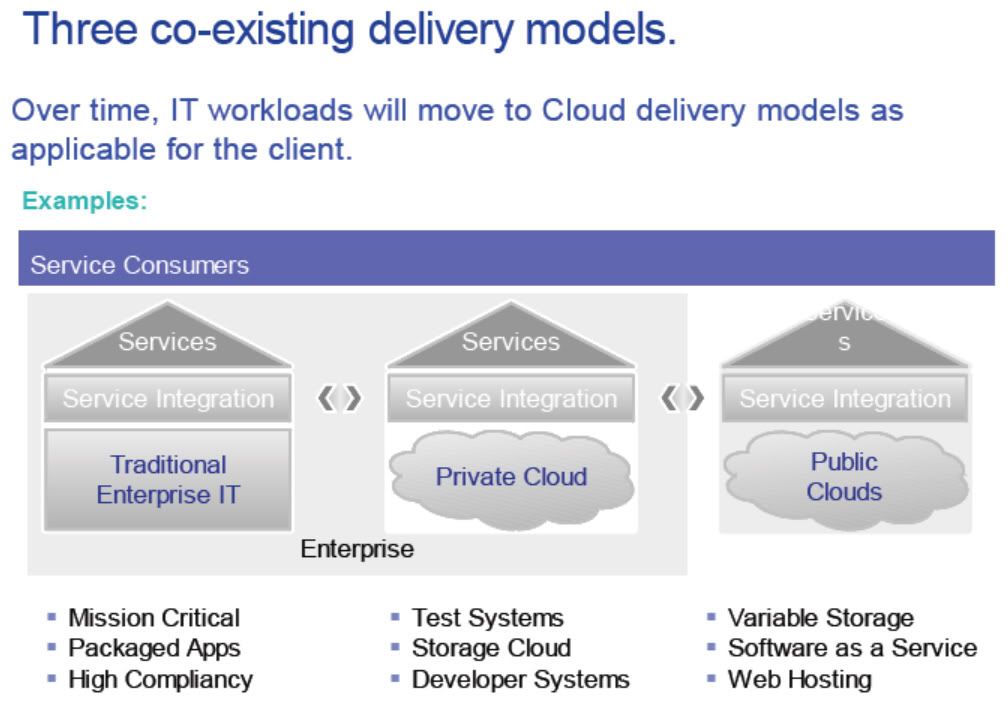
Three co-existing Cloud Computing delivery models

Post by devans00
________________________________________
________________________________________

Abstract of Talk

As the world becomes more and more global, integrated and "flat", it is also facing an array of problems: a financial crisis, climate disruption, energy geopolitics, food supply hazards etc. This is coinciding with technological innovations such as the following developments that can assist in resolving these problems:

The world is becoming instrumented. There are a billion transistors per human, each one costing one ten millionth of a cent.

Cloud computing and mobile computing are changing how software is deployed and used throughout the world.

All things are becoming intelligent. Algorithms and powerful systems turn those mountains of data into decisions and actions that can make the world work better. Smarter.

As the world's leading globally integrated IT company, IBM is attempting to use modern IT technology to tackle many of the world's problems. In this presentation, Lennart Frantzell will talk about IBM's global smarter planet initiative in its quest to make the world a smarter place.

IBM presentations of their cloud computing offerings available on cloud homepage.

About the Speaker
Lennart Frantzell, PhD, is a technical consultant at the IBM Innovation Center, San Mateo. He works with IBM Business Partners and startup companies in the IBM smarter planet initiative. The IBM Innovation Centers is a world-wide network of IBM business partner centers that provide business- and technical support to help companies get started and deploy applications in the IBM smarter planet space.

Lennart Frantzell has expertise in Cloud Computing, IBM Industry Frameworks, IBM Tivoli systems management, WebSphere and other IBM middleware products. He has worked in artificial intelligence, object-oriented programming and computer games.


Thursday, January 21, 2010

Marketing and the Cloud - I

Cloud Computing raises some interesting questions about marketing. How can/should cloud companies market their services? Does Cloud Computing change marketing? How? How do social media play into the marketing mix? How does a latter-day marketing organization use the cloud to drive business? Undoubtedly, there are many other questions, and perhaps this blog can surface and answer some of them as we go along.

We’ll pose the questions one at a time, create a stake in the ground around a potential answer, and look for some collective wisdom.

Let’s start with the broad question, “Does Cloud Computing change Marketing?” At its core, I think the answer is no. Marketing still has the same set of goals: building and sustaining a Brand; finding, attracting, and (perhaps) acquiring customers; understanding, selecting and conditioning target markets; listening to customers and prospects to inform both the brand and future offerings, and shortening the selling cycle for sales and partners.

However, what do change are the processes and tools that can be used to achieve those goals. These tend to fall into three broad categories:

1) Listening tools: In the past, it was difficult to understand how your brand was perceived, or how your product experience was rated, except through cumbersome, time-consuming, and not-very accurate surveys, or focus groups. Today, with a variety of social media tools, it’s possible to listen and respond to customer conversations about your company, and to leverage that knowledge directly into your company strategy.

2) Content Management: Using the Cloud as a repository for marketing tools (brochures, sales tools, presentations, etc.) facilitates communication with, and support for, sales teams, partners and even customers. Access can be managed, usage monitored, and actionable feedback collected from a broader audience than in the past.

3) Customer acquisition: Many potential customers are in the Cloud already – on social media, conducting searches, asking questions, and interacting with self-selected peer groups. The ability to find and listen to these conversations, to engage without disruption, and to attract potential users is fast becoming an art/skill that can set one competitor apart from the others.

In future posts, we’ll look to dissect each of these questions and categories a little more. Meanwhile, all flak, questions, comments, etc. are gratefully requested.


Jim Lee

Tuesday, October 27, 2009

MySQL gets cloudy with Amazon's new database service

Amazon is offering a new relational database service for EC2 that is powered by MySQL. (By Ryan Paul, October 27, 2009)

Amazon is expanding its Elastic Compute Cloud (EC2) infrastructure with a new offering based on the open source MySQL database system. The Amazon Relational Database Service (RDS) allows users to rent database capacity in the cloud and use it just like a regular MySQL database. Amazon has also introduced support for a new class of EC2 instances intended for high-memory workloads.

Amazon's EC2 service is an increasingly popular solution for deploying Web applications in the cloud, but its database options were previously somewhat limited. Amazon offers a custom database system called SimpleDB that is designed to store rows with simple attribute/value pairs. It lacks the sophisticated features of true relational databases and obviously isn't compatible out of the box with the multitude of existing Web applications that are designed to work with SQL. The new RDS option is a welcome enhancement for EC2 and it addresses one of the service's major deficiencies.

EC2 customers will be able to obtain RDS capacity by renting Amazon DB instances. The cheapest package, the Small DB Instance, provides 1.7GB of RAM and 1 ECU* for $0.11 per hour. A large instance provides 7.5GB of RAM and 4 ECUs for $0.44 per hour. There are five different packages altogether, the most expensive of which is the Quadruple Extra Large DB Instance, which provides 68GB of RAM and 26 ECUs for $3.10 per hour.

The Quadruple Extra Large instance is also available for regular EC2 computing for $2.40 per hour. Amazon introduced it today along with a Double Extra Large instance which provides 32GB of RAM and 13 ECU. Regular EC2 Double Extra Large instances cost $1.20 per hour and the RDS variant costs $1.55 per hour. RDS data storage capacity can be provisioned for $0.10 per GB. The database service includes an automated backup feature that can use the provisioned database storage.

"RDS provides cost-efficient and resizable capacity, while managing time-consuming database administration tasks for customers. The service takes much of the hassle out of setting up and managing relational databases, such as backups and code patching, freeing up its users to focus on their applications and business," wrote Amazon CTO Werner Vogels in a blog entry. "Amazon RDS provides the full capabilities of a MySQL Database, which means that libraries, applications and tools that have been designed for use with MySQL can be used without modification."

Indeed, EC2 users have already figured out and documented the proccess of deploying Django on Amazon's cloud using RDS for database hosting. RDS is clearly a lot easier than trying to manually set up and manage MySQL on EC2 with Elastic Block Storage (EBS).

Amazon's cloud services are evolving and becoming increasingly affordable, but aren't quite ready for everyone yet. Recent studies show that the service still can't match the uptime of in-house data centers and isn't cost-effective for large enterprises with heavy workloads. Amazon aims to change that eventually. In addition to the new features, the company has also announced plans today to reduce per-instance EC2 pricing next month. Amazon says that reduction, which is as much as 15% for some kinds of instances, was made possible by ongoing efforts to bring down its operating costs.

http://arst.ch/9b7

*Note: ECU = "EC2 Compute Unit". One ECU provides the equivalent CPU capacity of a 1.0-1.2 GHz 2007 Opteron or 2007 Xeon processor.

Monday, October 26, 2009

Ping Li comments on Big Data In The Cloud

I briefly spoke with Ping Li (VC firm Accel) at the Orrick event on "Loving The Cloud" which I wrote up earlier. Over the weekend he posted the following which expands on that subject:
http://gigaom.com/2009/10/25/the-future-is-big-data-in-the-cloud/

=Bill=

Hadoop presentations

I attended the Hadoop Users Group on 10/21/09 over at Yahoo! HQ where 3 different speakers made presentations. Their slide decks have now been posted at: http://tiny.cc/Hadoop_User_Group_Oct_21

=Bill=

Saturday, October 24, 2009

Yahoo! is hiring for Hadoop team

This might be of interest to the CSIX Cloud SIG. One of the best examples of new applications made practical by cloud computing is an Apache open source project named Hadoop. The biggest contributor (by far) to the Hadoop project is Yahoo! They are looking to expand their team as described below. Sorry, I don't have any internal contacts there. =Bill=

Yahoo! Inc. - Cloud Team SW Architects & Engineers - Hadoop, MapReduce, databases & database internals
Contact jwallace@yahoo-inc.com

Software Architects & Engineers Sunnyvale CA, USA
Yahoo! is looking for engineering team members to work on MapReduce and related projects that build database abstractions on top of Apache Hadoop. Understanding of distributed computing, databases, data warehouses, and especially database internals is a big plus. The Hadoop team moves as fast as any startup does, even though the scale of the problems it solves would make any startup founder deeply envious. We need engineers who can develop systems that can handle multi terabytes of new data daily and which runs on thousands of machines. The Hadoop team is growing fast! This is not surprising - all of Yahoo! batch data processing is moving to Hadoop, and we need many more great people to join this team.

For a complete list of available positions please contact jwallace@yahoo-inc.com An example of what we seek is below:

We are looking for great Software Architects & Engineers who have a wealth of experience with complex distributed software systems, algorithms, data structures, and performance optimizations. Understanding of grid computing, databases, data warehouses, and especially database internals is a big plus. Solid Java skills are required. Experience with agile development and open source development is desired. 6+ years of relevant software development experience are desired. Please advise me as to your interest and send me a resume. Also feel free to send me a LinkedIn invite so we can stay in touch.

Thanks,
John Wallace
Talent Acquisition Team
Advertising Technology, Cloud Computing & Search jwallace@yahoo-inc.com netrecruiter05@yahoo.com
http://www.linkedin.com/in/wwwrecruiter

Monday, October 19, 2009

CSix Eco-Green Website

The following message thread occurred in the old CSix Cloud Computing Yahoo Group starting 10-19-9. The text was transferred in case anyone wants to continue the discussion here.


CSIX Eco-Green website

Posted by: "bill_slagle"   bill_slagle

Mon Oct 19, 2009 9:48 am (PDT)

The CSIX Eco-Green SIG (EGG) has their website up and running. If you
want to take a look then see http://www.ecogreen group.org

I think it's interesting that they are using a Content Mgmt System (CMS)
called Joomla. I attended the Drupal BAD Camp this weekend at
UC-Berkeley. I wonder how Joomla and Drupal compare? Just curious.

=Bill=


Re: CSIX Eco-Green website

Posted by: "Glenn Reitsma"  greitsma

Mon Oct 19, 2009 9:56 am (PDT)

Joomla and Drupal are very similar. From what I've read Joomla is a bit
easier to learn and get something up quickly while Drupal has greater
flexibility but with a steeper learning curve to get started building the
site. Once the site is built the content management is easy from either one.

Glenn Reitsma
408-307-3058

http://glennreitsma .emurse.com/ (on-line resume)
http://www.linkedin .com/in/glennrei tsma


Re: CSIX Eco-Green website

Posted by: "Raj V"  rajvish

Tue Oct 20, 2009 10:22 am (PDT)

It would depend on the job.

Joomla is very good if you want  a  quick professional looking site. But Joomala has its own way of looking at things.

Drupal is more complicated but has a better abstraction that makes it a better Content Management System and Framework.

I also notice that Drupal seems ( no numbers yet) to consume less system resources than Joomla.

Having said that they are fast approaching the status of "What is better? Emacs or vi?"

Googling Drupal Vs. Joomla produces 4,650,000  sites. :-)

Raj