Showing posts with label Cloud computing. Show all posts

Wednesday, May 19, 2010

Cloud Enablers

We had a brief discussion at one of the meetings recently. One member asked what VMware's relationship to Cloud Computing is. I think there was some agreement that virtualization is an enabler of CC, but we didn't get to the crux of how it is one. I've seen some discussions which put Cloud Computing at the intersection of a number of technological advances, but it seems to me that there are three technologies that get the nod as economic enablers of CC. Without these three, the financial numbers don't work out for putative CC providers, and therefore, for the industry.

Virtualization is certainly one economic enabler, allowing a single server to hold multiple instances of an application, and thereby drive utilization, multitenancy, and rapid re-provisioning in the datacenter.

A second economic enabler is SaaS. This allows centralized management of applications, reduces the cost and complexity of upgrades and release management, and allows new generations of end user devices to have access to heretofore inaccessible computing resources and functionalities.

Finally, there is the hardware component - blade computers. As blades became mainstream, datacenters were able to scale horizontally, but without the space, power, and cooling concerns that plagued large datacenters in the era of "server racks". Now, the same footprint in a datacenter can accomodate 4-16 times the number of compute engines, (each a potential virtualization platform) and each with an acquisition cost that averages 1/4 to 1/3 of the typical cost of a rack-based server of the previous generation.

With these three technologies in place, the idea of offering on-demand computing became economically viable as a business model. The financial value proposition to the end user could be realized at a substantial profit to the supplier.

Of course there are many more technologies that were needed, and continue to be needed, but these are enhancers, in my view, not necessarily enablers. Storage virtualization, management paradigms, security, secure multitenancy, etc. are all critical technologies, but they allow differentiation, value creation, and cost optimization. While their impact is partly economic, they enhance, not enable the business model.

Your comments welcome.

Jim

Saturday, April 3, 2010

Chatter!!


Chatter is a new way for people to communicate in the company. It is considered Salesforce.com’s collaboration cloud. It allows an individual the opportunity to follow anyone in the company on any project. Everything is in one place, Chatter has the same collaboration features on Facebook or Twitter combined with the sharing and security rules of Salesforce. One of the coolest things about Chatter is the filters, you can follow just your team or you can follow your largest account, it is your call. Twitter is also integrated into this tool, when relevant accounts or topics get mentioned on Twitter it goes into the Chatter feed. Preview and comment on a newly posted project plan directly in the feed. It also allows you to follow back end applications such as HR. Custom apps that are developed on the force.com platform will update automatically to a live feed that filters into Chatter. You can follow everything that goes on inside of the company making sure no one is left out of the loop. With the force.com platform, you can track any data you want, such as orders, discounts, references, competitors... anything. This CRM app reflects your business in a real time feed which, allows developers using force.com to build a social app with just a few mouse clicks. Of course Chatter works with your iPhone and Blacberry. Real time insights that lead to better decisions that is what Chatter stands for!!


Thursday, February 11, 2010

Cloud Computing meets Smarter Planet Initiative

Earlier this week, I attended an IEEE Cloud Computing meets IBM's Smarter Planet Initiative event put on by the Santa Clara Valley Chapter Computer Society. The speaker, Lennart Frantzell, PhD of the IBM Innovation Center, San Mateo, has the goal of pushing technology until computers replace mankind.

Cloud Computing Adds Value in Specific Ways

The core of Cloud Computing made up of
- virtual machines
- high capacity broadband
- open source SW
- smartphones
- app stores such as Amazon Web Services (AWS)

I liked how Lennart Frantzell tied in current trends of smartphones and social networking to the growth of cloud computing. Without demand for more bandwidth and vendor neutral infrastructure by web users, the challenge of cloud computing activity may have stayed in the enterprise domain. Social networking is driving the growth of cloud computing.


Cloud Computing Globalization and Globally Available Resources

Frantzell explained how IBM Innovation Centers play a role in expanding the global digital infrastructure. A behind the scenes innovator in converting the world from analog to digital. The demo of one hospital based Cloud Computing implementation looked a lot like Big Brother. Wearable tracking systems allow computers to determine how well a doctor sticks to a predetermined checklist. Medical practitioners are at risk for being beeped at for failing to wash their hands long enough. The level of remote monitoring gave me shivers. Other remote management, like reading energy meters, are less intrusive.

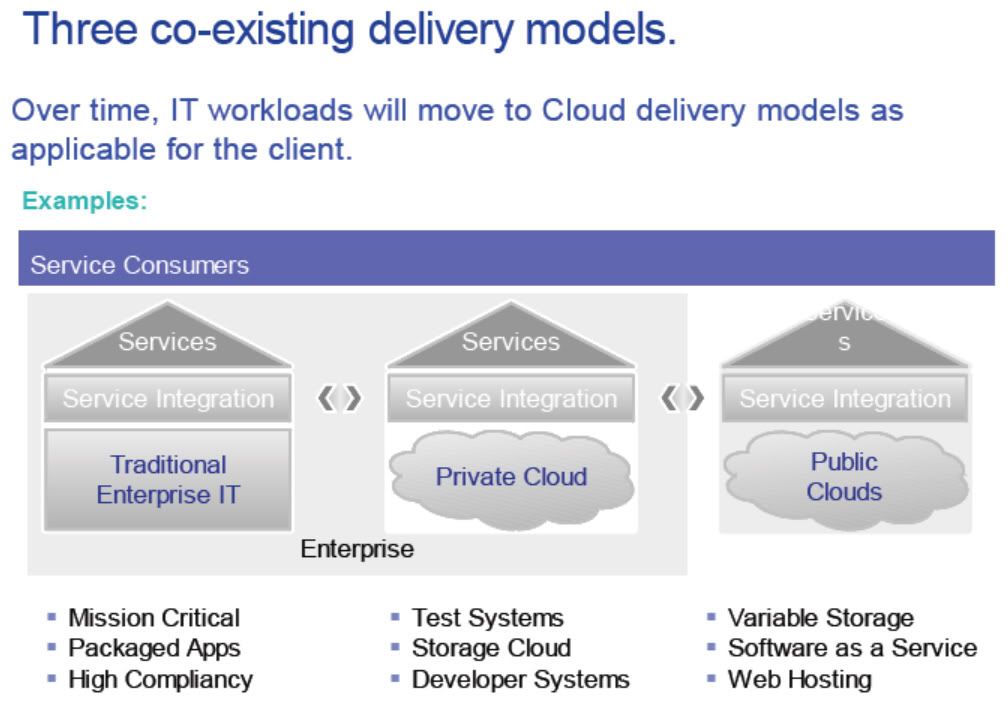
Lennart Frantzell also discussed the differences between private clouds, public clouds and hybrid clouds and how they interact. Hybrid and public clouds can act as storage or computing capacity backup or fail over. Hybrid and public clouds give enterprises the flexibility to have an internal private cloud as well immediate ability to absorb short term spike in need.

Three co-existing Cloud Computing delivery models

Post by devans00
________________________________________
________________________________________

Abstract of Talk

As the world becomes more and more global, integrated and "flat", it is also facing an array of problems: a financial crisis, climate disruption, energy geopolitics, food supply hazards etc. This is coinciding with technological innovations such as the following developments that can assist in resolving these problems:

The world is becoming instrumented. There are a billion transistors per human, each one costing one ten millionth of a cent.

Cloud computing and mobile computing are changing how software is deployed and used throughout the world.

All things are becoming intelligent. Algorithms and powerful systems turn those mountains of data into decisions and actions that can make the world work better. Smarter.

As the world's leading globally integrated IT company, IBM is attempting to use modern IT technology to tackle many of the world's problems. In this presentation, Lennart Frantzell will talk about IBM's global smarter planet initiative in its quest to make the world a smarter place.

IBM presentations of their cloud computing offerings available on cloud homepage.

About the Speaker
Lennart Frantzell, PhD, is a technical consultant at the IBM Innovation Center, San Mateo. He works with IBM Business Partners and startup companies in the IBM smarter planet initiative. The IBM Innovation Centers is a world-wide network of IBM business partner centers that provide business- and technical support to help companies get started and deploy applications in the IBM smarter planet space.

Lennart Frantzell has expertise in Cloud Computing, IBM Industry Frameworks, IBM Tivoli systems management, WebSphere and other IBM middleware products. He has worked in artificial intelligence, object-oriented programming and computer games.


Thursday, January 21, 2010

Marketing and the Cloud - I

Cloud Computing raises some interesting questions about marketing. How can/should cloud companies market their services? Does Cloud Computing change marketing? How? How do social media play into the marketing mix? How does a latter-day marketing organization use the cloud to drive business? Undoubtedly, there are many other questions, and perhaps this blog can surface and answer some of them as we go along.

We’ll pose the questions one at a time, create a stake in the ground around a potential answer, and look for some collective wisdom.

Let’s start with the broad question, “Does Cloud Computing change Marketing?” At its core, I think the answer is no. Marketing still has the same set of goals: building and sustaining a Brand; finding, attracting, and (perhaps) acquiring customers; understanding, selecting and conditioning target markets; listening to customers and prospects to inform both the brand and future offerings, and shortening the selling cycle for sales and partners.

However, what do change are the processes and tools that can be used to achieve those goals. These tend to fall into three broad categories:

1) Listening tools: In the past, it was difficult to understand how your brand was perceived, or how your product experience was rated, except through cumbersome, time-consuming, and not-very accurate surveys, or focus groups. Today, with a variety of social media tools, it’s possible to listen and respond to customer conversations about your company, and to leverage that knowledge directly into your company strategy.

2) Content Management: Using the Cloud as a repository for marketing tools (brochures, sales tools, presentations, etc.) facilitates communication with, and support for, sales teams, partners and even customers. Access can be managed, usage monitored, and actionable feedback collected from a broader audience than in the past.

3) Customer acquisition: Many potential customers are in the Cloud already – on social media, conducting searches, asking questions, and interacting with self-selected peer groups. The ability to find and listen to these conversations, to engage without disruption, and to attract potential users is fast becoming an art/skill that can set one competitor apart from the others.

In future posts, we’ll look to dissect each of these questions and categories a little more. Meanwhile, all flak, questions, comments, etc. are gratefully requested.


Jim Lee